In the laser module (e.g. A40640), two laser beams are combined. The brochure shows combining of the two beams by a “plate”, which might be the physical reality only in the case of dichroitic combination or polarization combination. Thus, my question is whether the beam combining is realized by such a polarization or dichroitic combination or by another effect (which one)? Thanks, Stephan
polarization combination
Thank’s, Jim; I’m really happy with the physical understanding !-)
Greetings, Stephan
Wrongly, it’s an ordinary “translucent mirror” with an anti-glare coating on one side. You can see it all in the photo. And most importantly, there are no “fast axis” compensation lenses, which makes the beam appear rectangular (on average 0.1 x 0.25 mm)…
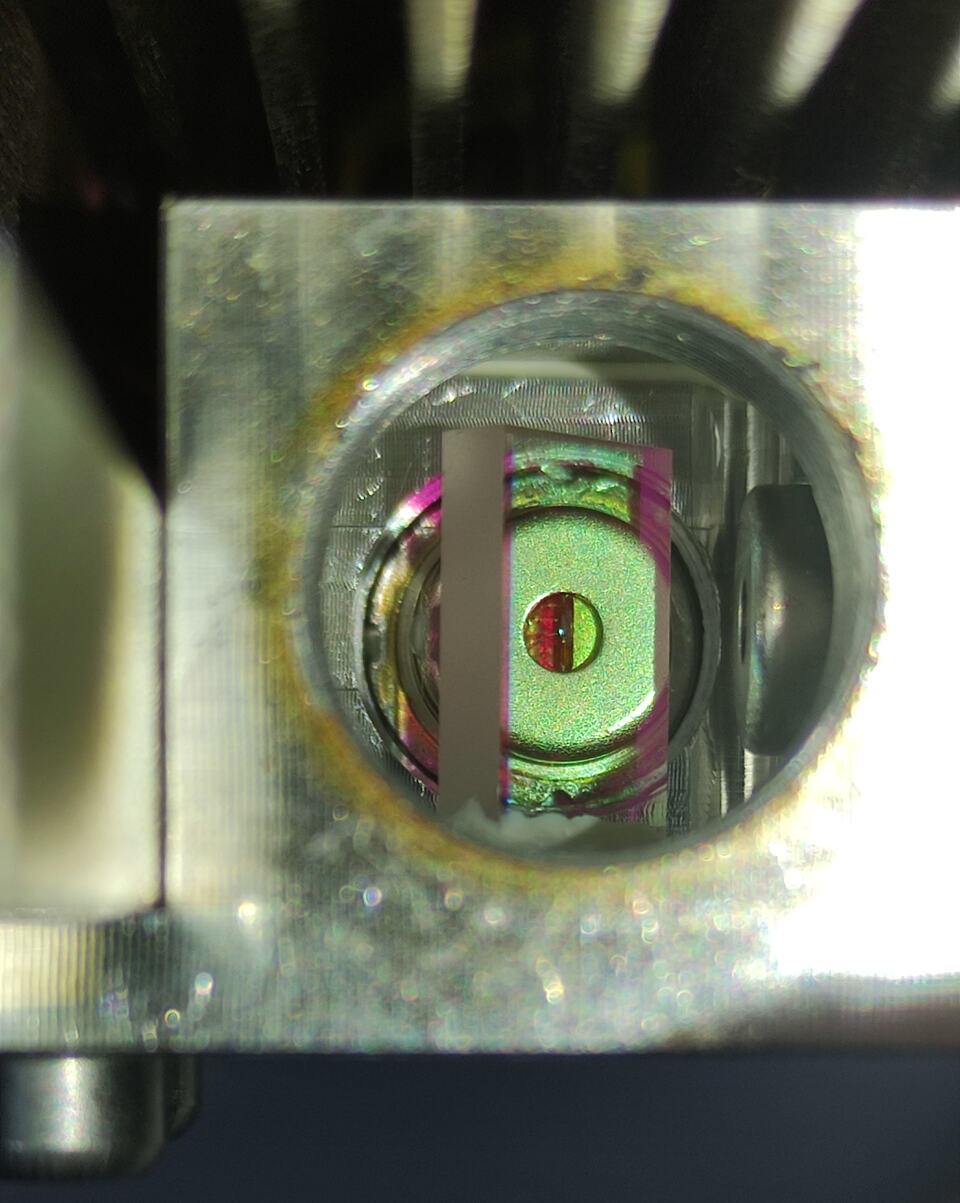
And, most importantly, used laser diodes have been used (the cage is soldered, as can be seen in the photo)
Thanks for your expertise. But how does it work (physically) with such a simple “semi-transparent” mirror? When halves of each beams are combined, than the other halves of the beams are reflected back resp. transmitted. Thus, there is no benefit of using two laser diodes. Perhaps you might send me a link (e.g. Wikipedia?) for explaining the physical principle?
The special feature of this “mirror” is a special “illuminating” coating, which, on the one hand, transmits a given wavelength (440-450 nm), and on the other hand, it completely reflects it.
To get started, it’s worth exploring the “basis”:
Next is the “Beam splitter” itself:
Thank you for the citations, these reflect my knowledge:
A “Beam Splitter” splits a beam of light into transmitted and reflected beam. This device might be constructed by triangular glass prisms (cited article), or it might be a glass plate (as shown in your photo).
When such a glass plate comprises multiple dielectric layers (“Dielectric mirror”), different reflectivity at different wavelengths can be realised: nearly complete light at one wavelength might transmit the glass plate and nearly complete light of a different wavelength might be reflected; as a result, both lights can be combined, the combined beam comprises the light ower of both light beams.
But: the two light beams must have different wavelengths; and I cannot imaging that the laser diodes are wavelengths selected (not for that price).
“Optical coating” allows reflection of defined amount for a large wavelengths bandwidth: a beam combining is realizable but the beams are always combined in transmit and reflection direction; very well useable when two sensors are to be used for the two beams. No doubling of the beam power is possible. On the other hand, with optical coatings the dielectric mirror layers (above) are realizable.
According to my understanding, also with optical coatings, a polarization dependent reflection/transmission might be realized. Such a layered glass plate indeed can combine two input beams to one combination beam, having the power of the two input beams (but still with different polarization direction). This is what I suppose the effect with the present laser module.
Now you define a mirror comprising an “illuminating” coating, which (for a narrow wavelength range) totally transmits and completely reflects light. It is totally unclear for me, how this works. Even with the Wikipdia citations (not only the shortened, but also the comlete ones) I cannot derive the working principle of such an “illumination” coating which fully combines beams of equal wavelengths and equal polarization.
To understand, you just need to “split” the beam-splitter plate into two separate optical systems:
- a system that allows the “passing” beam to pass through without reflection (the diode behind the mirror) through the “mirror”
- a polarizer plate that is at a 45-degree angle to the beam (the body of the “mirror”)
- a system that completely reflects the beam that falls on the mirror (the diode in front of the mirror on the side).
The first “system” has coatings on both sides of the plate that allow the beam to pass through almost without reflection. Yes, polarization does affect it, but remember that the polarization also changes when the beam passes through the 45-degree plate. Therefore, once the beam enters the plate, it can only exit it.
The third system is simply a “dielectric mirror” that reflects the beam that falls on the plate and “releases” the second beam that is already present in the plate without re-reflection.
The A40640 module fundamentally adopts a beam combining solution combining fiber collimation + fast-axis compression with semi-transparent beam splitter plates.
Early batches use original Nichia laser diodes processed with fiber compression, while later versions feature cap-free original Osram diodes with customized fiber packaging. All diodes are brand-new factory parts with reliable quality and never recycled used components.
Marks left on early Nichia bare dies stem from standard bin sorting during original factory production, which is a normal manufacturing trace and not evidence of second-hand stock.
This module integrates dual-focal-length design with both short-focus and long-focus optics: the short-focus spot measures roughly 0.04×0.08 mm, and the long-focus spot ranges from 0.1 mm to 0.2 mm. Such dual-focus configuration delivers high flexibility for scanning and engraving applications, which is the core design feature of this product.
Hello megagad, dav, once more thnaks for the conotribution on understanding the fundamentals.
From the former discussion I want to repeat once more the two combining principles (with a collinear output beam).
First, there is the dichroitic beam combiner, combining laser beams of different wavelengths; this is shown as a commercial product in the following link and the functional diagram:
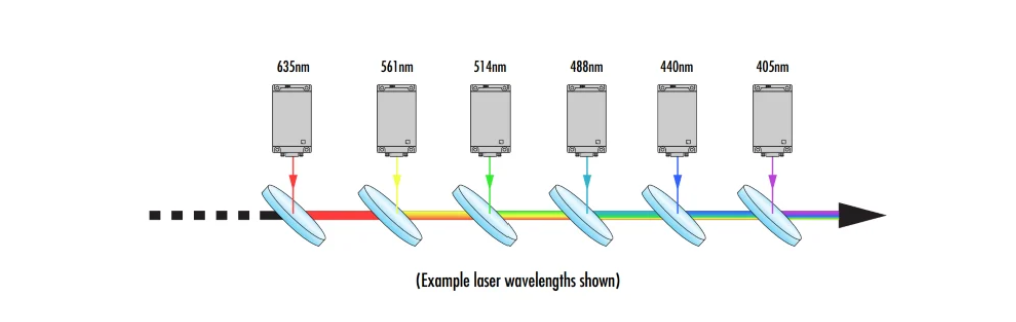
I think, we agree that this is not the principle of the two laser combiner in the NEJE A40640 and related two-laser modules.
Second, there is the polarization beam combining, which is explained in the following link:
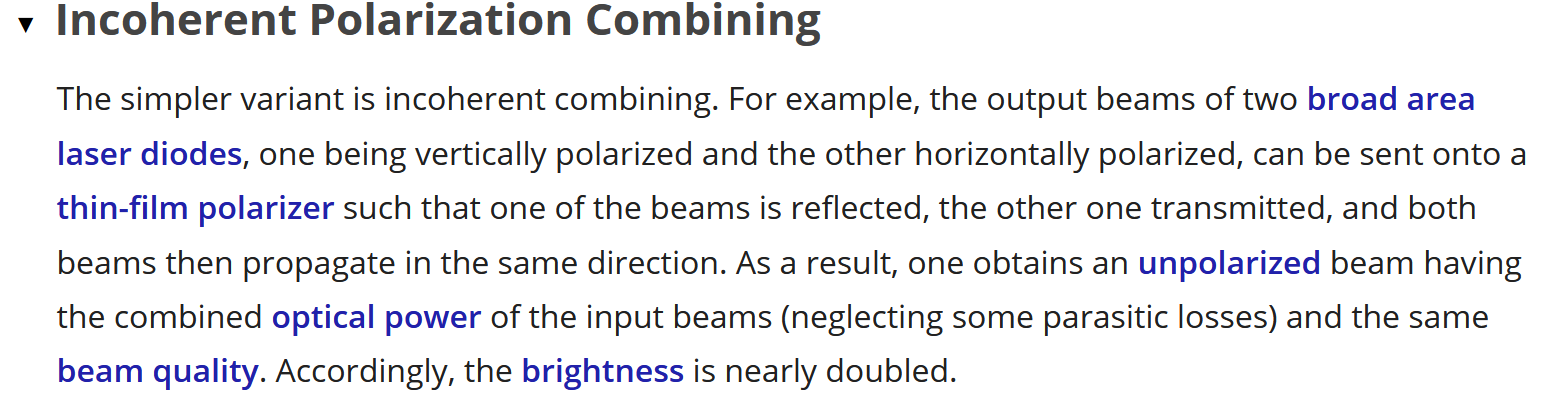
@megagad, from your last contribution I identify this second beam combining principle, which I had in mind from the beginning and which I understood from @Jim.
Or I’m wrong???
@dev, from your contribution I identify, that fast/slow diode laser axis are manipulated by fiber collimators in order to reduce laser beam ellipticity. Nevertheless, you further refer to “semi-transparent” beam splitter plates. In my opinion, beam combining for reaching double output power is not possible with such pure “semi-transparent” beam splitters: half beam power is reflected and transmitted for both beams, thus the reflected beam as well as the transmitte beam boths comprise half of both laser beams (if the beam splitter is designed 50/50).